Here is an iteresting article I found on the Petit-Mécatina River Québec North Shore a gem in peril
From

Rivière du Petit Mécatina
Special Note- This story appeared in Canoe and Kayak Whitewater 2008 pages 40-43 Below is the original unedited version (somewhat different than in the magazine). I feel it is necessary to get this information out there and that is why it is reprinted here. Sorry if I inconvenience anyone, but this is an important issue. Anyone interested in paddling the Mecatina should and take lots of photos and video. It too may not be around for much longer. Thanks to Pat Camblin for allowing me to use some of his awesome photographs.
..........................the infamous ferry move
 -photo courtesy Pat Camblin
Last September (2007) a group of us kayakers went to explore an unrun canyon and rapids of the Petit Mecatina River. It was an epic trip as we found ourselves amidst a true whitewater classic. Long days, remote river, difficult whitewater, creative routefinding, and spectacular scenery. Here is the story and photos of that trip. The Mecatina is also under study for a 1500 MW hydro project that would consist of three dams. We saw first hand the surveying that had already been done along the river. It would be a true shame to lose such an incredible free-flowing river.


Riviere Du Petit Mecatina
By Fred Coriell
The Beaver’s engine rattled and sputtered as Leonard DuReps did his preflight warm-up lap around the lake. It was nearly noon and six hours past our anticipated departure time. I could see Willy Kern nodding off in the co-pilot seat and Eric Boomer had his face firmly pressed against the kayaks inside the plane. -photo courtesy Pat Camblin

 One in particular, just above a place called Granite Island Rapid, Boomer ran out in the main flow executing a timely subsurface paddle at the bottom of a watery ramp. It was exciting big water paddling.
 -photo courtesy Pat Camblin
 The surrounding shore lines began to tighten their grip on the river’s course. In the distance cliffs sprang out of the valley floor stacking in bands of rock and boreal vegetation. Two grey domes topped with a rich hue of moss and black spruce rose taller than the rest. The river was deeply entrenched between them.
 It was nearly three o’clock and we were about to commit ourselves into the canyon. A couple of pushy lead-in rapids and we were out of our boats looking at one of two named rapids on the map, La Grande Truite (The Big Trout).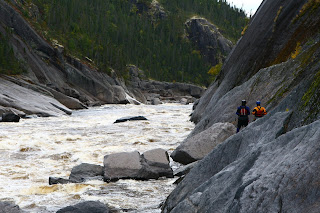
 The Mecatina dropped over a 10 meter falls, squeezed between solid bedrock flanks, creating a frothy white storm that boiled wildly into chaos. There was a steep rocky ramp leading to a cave below the falls and an obvious way downstream.

 Looking back upstream at the watery chaos the scale of the Mecatina showed itself again. The raucous boil at the base of the falls surged with such fury it blocked the lower half of the drop from view. We floated around another corner and the canyon walls receded.
 Then several long pools and rapids that split around islands making different channels of whitewater.
..........................the infamous ferry move
-photo courtesy Pat CamblinLast September (2007) a group of us kayakers went to explore an unrun canyon and rapids of the Petit Mecatina River. It was an epic trip as we found ourselves amidst a true whitewater classic. Long days, remote river, difficult whitewater, creative routefinding, and spectacular scenery. Here is the story and photos of that trip. The Mecatina is also under study for a 1500 MW hydro project that would consist of three dams. We saw first hand the surveying that had already been done along the river. It would be a true shame to lose such an incredible free-flowing river.
Riviere Du Petit Mecatina
By Fred Coriell
The Beaver’s engine rattled and sputtered as Leonard DuReps did his preflight warm-up lap around the lake. It was nearly noon and six hours past our anticipated departure time. I could see Willy Kern nodding off in the co-pilot seat and Eric Boomer had his face firmly pressed against the kayaks inside the plane.
The long drive out the mighty Saint Lawrence River to the eastern endpoint of highway 138 in the town of Natashquan, Québec was beautiful, but frenzied. Several minor detours including screeching the car to a halt at every river crossing and an empty gas tank around midnight had slowed us down enough to realize the window of time was rapidly closing.
Originally we intended to fly into the Petit Mecatina River on Sunday giving us six and a half days to paddle 120 miles and negotiate a canyon that had spawned several near legendary stories of portaging. The crux of the plan, besides the canyon, was catching a weekly ferry out of Harrington Harbour, a small fishing village near the mouth of the river, at 7pm the following Saturday. There are no roads in this part of Québec. The 12 hour ferry ride is the only public transportation linking Harrington Harbor and highway 138 in Natashquan. Miss the ferry and we have to wait another week.
Now it was Monday and only time for one plane load before dark. It would be almost noon on Tuesday before the other two plane flights arrived and we could begin the paddle. The only good news, it seemed, was that Leonard thought he could land directly above the gorge we intended to paddle. Thus, shortening the trip 30 miles and gaining back one of the days we had already lost.
Originally we intended to fly into the Petit Mecatina River on Sunday giving us six and a half days to paddle 120 miles and negotiate a canyon that had spawned several near legendary stories of portaging. The crux of the plan, besides the canyon, was catching a weekly ferry out of Harrington Harbour, a small fishing village near the mouth of the river, at 7pm the following Saturday. There are no roads in this part of Québec. The 12 hour ferry ride is the only public transportation linking Harrington Harbor and highway 138 in Natashquan. Miss the ferry and we have to wait another week.
Now it was Monday and only time for one plane load before dark. It would be almost noon on Tuesday before the other two plane flights arrived and we could begin the paddle. The only good news, it seemed, was that Leonard thought he could land directly above the gorge we intended to paddle. Thus, shortening the trip 30 miles and gaining back one of the days we had already lost.
-photo courtesy Pat Camblin
With half closed eyes I watched the taiga, its huge forests of black spruce and balsam fir and the endless lakes and rivers connecting them. In all, the three of us on the first flight had it good. We could get some much needed rest and contemplate a river that was currently flowing within our reach.
The Petit Mecatina is the longest river in Québec’s North Coast region. Its headwaters overflow with lakes draining across the Canadian Shield and off the Lower North Shore Plateau. Broad river valleys flanked by smooth granite bubbles shaped by endless glaciations and the slow steady progress of the giant river system are remnants of the archaic mountain ranges that once stood proud. Since 1977 there have been a handful of descents down the river. A 1985 Canoe Magazine article describes a trip that year by Sergey Theoret who also ran the river first in 1977. He returned with tales of an impassable canyon, but described a portage route on the western side of the river. In 1986 Eric Lindbergh led a trip with three kayaks. They began at Lac Breton, our original planned starting point, paddled into the canyon and portaged for a day and a half on the eastern side of the river around the rapids that make up the heart of the gorge. Most recently in 2003 a group of canoes paddled from the Mecatina’s headwaters 500 km to the ocean. The “trip from hell” as described by their report lasted over three weeks with the canyon portage taking six days.
It is hard to grasp the scale of the Mecatina. The river is so big it looks still and the horizon lines seem to appear suddenly, only the sullen roar hinting at what lies ahead. Standing on billion year old bedrock Willy, Boomer, and I scouted the first set of rapids. We debated the river’s volume. Maybe 4,000cfs or 12,000cfs, it was difficult to decipher. Swimming pool sized potholes that disappeared into the abyss dotted the river bank. Large natural forces had been at work here for a long time. The place felt ancient.

On the right side of the river were several orange painted markers cloaked with sticks covered in orange flagging; a sight that would become all too familiar downstream. The Mecatina’s attributes, as well other large rivers on the North Coast, have attracted the will of modern civilization’s ever-increasing demand for energy. In the Hydro Québec Production Strategic Plan 2004-2008 it states “The Romaine development could be followed by a second major 1500-MW project on the Petit Mecatina River in the same region.” If approved the Romaine project could begin construction in 2009. The Mecatina may not be far behind. Attaining back to camp my thoughts immersed in a debate between a need for renewable energy sources and what the true costs are of those technologies. I concluded, at least for now, that we were fortunate, perhaps selfishly so, about to experience a journey through a still untouched and wild landscape.
The drone of the plane’s engine broke the morning silence as it crested the ridge. John Grace, Pat Camblin, and Anthony Yap arrived in the first load. Three hours later Tommy Hilleke, Billy Murphy, and Joe Barkley unloaded the last of the gear and in true bush pilot form Leonard departed ducking his right wing just over our heads. Nine of us headed downstream curious to feel the push of the river beneath our kayaks hopeful of negotiating the gorge by nightfall.
A smooth thick tongue of tannin colored water dropped 4 meters threading two large holes. The river abruptly changed from calm to frantic.
The Petit Mecatina is the longest river in Québec’s North Coast region. Its headwaters overflow with lakes draining across the Canadian Shield and off the Lower North Shore Plateau. Broad river valleys flanked by smooth granite bubbles shaped by endless glaciations and the slow steady progress of the giant river system are remnants of the archaic mountain ranges that once stood proud. Since 1977 there have been a handful of descents down the river. A 1985 Canoe Magazine article describes a trip that year by Sergey Theoret who also ran the river first in 1977. He returned with tales of an impassable canyon, but described a portage route on the western side of the river. In 1986 Eric Lindbergh led a trip with three kayaks. They began at Lac Breton, our original planned starting point, paddled into the canyon and portaged for a day and a half on the eastern side of the river around the rapids that make up the heart of the gorge. Most recently in 2003 a group of canoes paddled from the Mecatina’s headwaters 500 km to the ocean. The “trip from hell” as described by their report lasted over three weeks with the canyon portage taking six days.
It is hard to grasp the scale of the Mecatina. The river is so big it looks still and the horizon lines seem to appear suddenly, only the sullen roar hinting at what lies ahead. Standing on billion year old bedrock Willy, Boomer, and I scouted the first set of rapids. We debated the river’s volume. Maybe 4,000cfs or 12,000cfs, it was difficult to decipher.
Swimming pool sized potholes that disappeared into the abyss dotted the river bank. Large natural forces had been at work here for a long time. The place felt ancient.On the right side of the river were several orange painted markers cloaked with sticks covered in orange flagging; a sight that would become all too familiar downstream. The Mecatina’s attributes, as well other large rivers on the North Coast, have attracted the will of modern civilization’s ever-increasing demand for energy. In the Hydro Québec Production Strategic Plan 2004-2008 it states “The Romaine development could be followed by a second major 1500-MW project on the Petit Mecatina River in the same region.” If approved the Romaine project could begin construction in 2009. The Mecatina may not be far behind. Attaining back to camp my thoughts immersed in a debate between a need for renewable energy sources and what the true costs are of those technologies. I concluded, at least for now, that we were fortunate, perhaps selfishly so, about to experience a journey through a still untouched and wild landscape.
The drone of the plane’s engine broke the morning silence as it crested the ridge. John Grace, Pat Camblin, and Anthony Yap arrived in the first load. Three hours later Tommy Hilleke, Billy Murphy, and Joe Barkley unloaded the last of the gear and in true bush pilot form Leonard departed ducking his right wing just over our heads. Nine of us headed downstream curious to feel the push of the river beneath our kayaks hopeful of negotiating the gorge by nightfall.
A smooth thick tongue of tannin colored water dropped 4 meters threading two large holes. The river abruptly changed from calm to frantic.
-photo courtesy Pat Camblin
A variety of underwater, over the water, and backender moves ensued. Then straight into another river wide feature. Instantly, the Mecatina was alive. Over the next couple hours we settled into a steady pace of leap frog scouting and follow the leader, running several big wave trains and a few standout rapids.
Over the next couple hours we settled into a steady pace of leap frog scouting and follow the leader, running several big wave trains and a few standout rapids.-photo courtesy Pat Camblin
One in particular, just above a place called Granite Island Rapid, Boomer ran out in the main flow executing a timely subsurface paddle at the bottom of a watery ramp. It was exciting big water paddling.-photo courtesy Pat CamblinThe surrounding shore lines began to tighten their grip on the river’s course. In the distance cliffs sprang out of the valley floor stacking in bands of rock and boreal vegetation. Two grey domes topped with a rich hue of moss and black spruce rose taller than the rest. The river was deeply entrenched between them.It was nearly three o’clock and we were about to commit ourselves into the canyon. A couple of pushy lead-in rapids and we were out of our boats looking at one of two named rapids on the map, La Grande Truite (The Big Trout).-photo courtesy Pat Camblin
A smooth steeply sloping granite slab formed the left side of the river. It rose several hundred feet up, too exposed to traverse. The right side was more of the same. We could portage the top of the rapid, but were committed to a ferry move above a ledge that mischievously hid itself from clear view. Willy and Tommy went long and scouted from high up the left side wall. If we could make the ferry across the river it looked possible to keep moving at river level and avoid a grim portage. It was a big “if”. The river was pushing hard. We powwowed trying to decipher aerial photographs and the left side scout. Willy thought if someone blew the ferry there was a thin line in the center of the river that would work if you paddled hard.
Of the first three to go only Boomer made the ferry. The rest of us watched in amazement as Pat, taking a heroic surf, held on long enough to be spit out downstream. Anthony, seeing the situation in front of him, turned his boat downstream towards Pat and paddled straight at the hole. He emerged in the outflow and upright. Convinced of a line we slid into our kayaks focused on making the move. Only four of nine made the ferry, but most importantly no more hole riding.
Around the next corner was a steep rapid with plenty of room to portage over house sized rocks on the right. People had been here before. Orange markers were spaced every hundred yards or so down both river banks. We scouted further to see what was making the tremendous rumbling that echoed loudly off the canyon walls.
Of the first three to go only Boomer made the ferry. The rest of us watched in amazement as Pat, taking a heroic surf, held on long enough to be spit out downstream. Anthony, seeing the situation in front of him, turned his boat downstream towards Pat and paddled straight at the hole. He emerged in the outflow and upright. Convinced of a line we slid into our kayaks focused on making the move. Only four of nine made the ferry, but most importantly no more hole riding.
Around the next corner was a steep rapid with plenty of room to portage over house sized rocks on the right. People had been here before. Orange markers were spaced every hundred yards or so down both river banks. We scouted further to see what was making the tremendous rumbling that echoed loudly off the canyon walls.
The Mecatina dropped over a 10 meter falls, squeezed between solid bedrock flanks, creating a frothy white storm that boiled wildly into chaos. There was a steep rocky ramp leading to a cave below the falls and an obvious way downstream.-photo courtesy Pat Camblin
-photo courtesy Pat Camblin
The other option was a ferry above the falls and a portage down rock slabs back to the river. Daylight was fading. John led a crew that opted for the ferry and everyone else portaged entirely on the right.
-photo courtesy Pat Camblin
Looking back upstream at the watery chaos the scale of the Mecatina showed itself again. The raucous boil at the base of the falls surged with such fury it blocked the lower half of the drop from view. We floated around another corner and the canyon walls receded.-photo courtesy Pat Camblin
The first stars flickered to light as we settled into camp.
The next day was a mix of rapids and long stretches of moving current. With the broadening river valley we delighted in a display of northern boreal waterfowl. Mergansers, bitterns, and watchful osprey crisscrossed the sky.
The next day was a mix of rapids and long stretches of moving current. With the broadening river valley we delighted in a display of northern boreal waterfowl. Mergansers, bitterns, and watchful osprey crisscrossed the sky.
-photo courtesy Pat Camblin
Even a lone wolf eyed us wearily from the river bank. We had traveled only 10 miles yesterday. Four days and 80 miles remained between us and the ferry. It seemed reasonable we would make it, but in short river kayaks the vast calm sections of the Mecatina became arduous work. Sometimes we would paddle in a line, drafting wakes and keeping a steady cadence of forward strokes. For breaks we rafted the boats together floating lazily in the current sharing snacks and checking our progress on the maps.
 Late in the afternoon the Mecatina flowed into a smaller less imposing canyon with long wave trains and a few big holes. Mostly we enjoyed trying to surf our gear laden kayaks. Joe took a ride while unsuccessfully trying to thread a couple of large crashers.
For breaks we rafted the boats together floating lazily in the current sharing snacks and checking our progress on the maps.Late in the afternoon the Mecatina flowed into a smaller less imposing canyon with long wave trains and a few big holes. Mostly we enjoyed trying to surf our gear laden kayaks. Joe took a ride while unsuccessfully trying to thread a couple of large crashers.-photo courtesy Pat Camblin
After several rounds in the hole he managed to jump his heavy kayak completely out of the water before continuing downstream. At the end of the canyon was an impressive rapid. Standing at the top the whitewater continued as far as we could see. More orange markers lined the river bank perhaps explaining why the map had exact elevations for the top and bottom of the rapid. We stayed close to the right shore, not tempting the middle of the river.
 -photo courtesy Pat Camblin
On the third morning we awoke with a strengthening southerly breeze. Unwelcome weather with more than 30 miles of flat water ahead. The windy conditions deteriorated throughout the day. Where there was current the wind pushed so hard it created standing waves. Again we formed a drafting line, heads down against the constant spray whipping our faces. An incredible set of glassy waves called Rapid de Pahtapistnakan came somewhere in the middle of the day. Everyone scrambled to put their spray skirts on in time for a surf. Had there been more time we would have stayed here for the night.
As the day wound down we passed a group of moose hunters from Tete-a-la-Beleine, a coastal village east of the Mecatina. They shared a few precious beers and informed us that we were close to the day’s goal.
At the end of the canyon was an impressive rapid. Standing at the top the whitewater continued as far as we could see. More orange markers lined the river bank perhaps explaining why the map had exact elevations for the top and bottom of the rapid. We stayed close to the right shore, not tempting the middle of the river.-photo courtesy Pat CamblinOn the third morning we awoke with a strengthening southerly breeze. Unwelcome weather with more than 30 miles of flat water ahead. The windy conditions deteriorated throughout the day. Where there was current the wind pushed so hard it created standing waves. Again we formed a drafting line, heads down against the constant spray whipping our faces.
An incredible set of glassy waves called Rapid de Pahtapistnakan came somewhere in the middle of the day. Everyone scrambled to put their spray skirts on in time for a surf. Had there been more time we would have stayed here for the night.As the day wound down we passed a group of moose hunters from Tete-a-la-Beleine, a coastal village east of the Mecatina. They shared a few precious beers and informed us that we were close to the day’s goal.
-photo courtesy Pat Camblin
Thanking them for the libations and a tour of their cabin we paddled the last few miles spending a windy night just above the place where the Mecatina divides into two channels.
Locals call it “The Split.” The western channel takes the name Netagamiou while the eastern keeps the name Petit Mecatina.
Locals call it “The Split.” The western channel takes the name Netagamiou while the eastern keeps the name Petit Mecatina.
-photo courtesy Pat Camblin
They flow about 10 miles apart, two very distinct rivers now. I could only venture a guess that over time nature’s forces had eroded the falls above the split far enough upstream that the river began pouring into another depression in the landscape eventually finding its way to the ocean. It also presented a decision that was answered the previous day by a satellite phone call to Larry Ransom. The Harrington Harbor wharf manager had secured us a boat ride from the bottom of the Mecatina at 6:30 the next morning. He explained we needed to be punctual since high tide was at 7am, or we would be on our own.
 The route was set which, to our surprise, held some of the best whitewater of the trip.
Below the split, with half the flow, the river crashed through a short bedrock gorge.
It also presented a decision that was answered the previous day by a satellite phone call to Larry Ransom. The Harrington Harbor wharf manager had secured us a boat ride from the bottom of the Mecatina at 6:30 the next morning. He explained we needed to be punctual since high tide was at 7am, or we would be on our own.The route was set which, to our surprise, held some of the best whitewater of the trip.Below the split, with half the flow, the river crashed through a short bedrock gorge.
-photo courtesy Pat Camblin
Then several long pools and rapids that split around islands making different channels of whitewater.-photo courtesy Anthony Yap
We explored each one thoroughly paddling the channels that looked most inviting.

-photos courtesy Pat Camblin
One last island, splitting a vertical waterfall and a sloping rapid into an abrupt slide, evoked lines of varying success. Tired, but thrilled about the last day’s whitewater, we slept at the base of the falls; its steady roar a last breath of a mighty river subsiding into the ocean.

 -photos courtesy Pat Camblin
The sun was just rising from the ocean as we floated out the mouth of the river. It turned the sky a brilliant orange that reflected brightly on the calm water.

 -photos courtesy Pat Camblin
The sun was just rising from the ocean as we floated out the mouth of the river. It turned the sky a brilliant orange that reflected brightly on the calm water.
-photo courtesy Pat Camblin
In the distance the sound of a motor was gaining volume. Before long we could make out a zodiac raft heading towards us. It was Larry and Paul Rowsell the mayor of Harrington Harbor. They towed us back to Paul’s fishing boat and we loaded everything on board.
-photo courtesy Pat Camblin
We were grateful for the ride. It saved us several hours of paddling and probably a few more of getting lost trying to navigate through the coastal topography. We docked in Harrington Harbor around eight in the morning. Word traveled fast in the small town ever since the call to Larry on Thursday. People were curious to hear about the trip through the canyon. Some of them said they had flown over it before and others were interested to know if we had seen any moose along the way. We spent the day wandering the island and talking to the locals.
Word traveled fast in the small town ever since the call to Larry on Thursday. People were curious to hear about the trip through the canyon. Some of them said they had flown over it before and others were interested to know if we had seen any moose along the way. We spent the day wandering the island and talking to the locals.-photo courtesy Pat Camblin
I inquired to Paul about the surveying we had seen along the river. He said that Hydro Québec was interested in the Mecatina for multiple generating stations and thought the project would be a good thing for the local economy. As isolated as Harrington Harbor is I could understand how a large scale construction project would improve access to the largely untouched mainland and create opportunities besides the commercial fishing industry that the town was built around.
The ferry left Harrington Harbor at eight the next morning. A fast moving, but strong storm had delayed its departure. Finally, after a long seasick ride through 4 meter seas we were back on solid ground in Natashquan. It was 11pm on Sunday night, exactly five and a half days since we began paddling down the Mecatina. The river had surprised everyone with its incredible and abundant whitewater and spectacular scenery. We would all return if the opportunity arose again and perhaps entice other groups to explore the river. I hope that opportunity will be soon. The increasing pressure to expand the generating capacity of the North Coast’s immense water resources is evident with several ongoing refurbishing projects of older dams and the study of new large scale projects including the Mecatina. Awareness of the largely untapped whitewater resources could potentially factor into future decisions concerning hydro development in the region. . The river has the potential to be regarded as one of the classic expeditionary whitewater trips. And it is still a pristine landscape that sees little human impact. The future of the Petit Mecatina is still uncertain. It would be a real tragedy to lose it forever.
The ferry left Harrington Harbor at eight the next morning. A fast moving, but strong storm had delayed its departure.
Finally, after a long seasick ride through 4 meter seas we were back on solid ground in Natashquan. It was 11pm on Sunday night, exactly five and a half days since we began paddling down the Mecatina. The river had surprised everyone with its incredible and abundant whitewater and spectacular scenery. We would all return if the opportunity arose again and perhaps entice other groups to explore the river. I hope that opportunity will be soon. The increasing pressure to expand the generating capacity of the North Coast’s immense water resources is evident with several ongoing refurbishing projects of older dams and the study of new large scale projects including the Mecatina. Awareness of the largely untapped whitewater resources could potentially factor into future decisions concerning hydro development in the region. . The river has the potential to be regarded as one of the classic expeditionary whitewater trips. And it is still a pristine landscape that sees little human impact. The future of the Petit Mecatina is still uncertain. It would be a real tragedy to lose it forever.

